Thursday, March 18, 2021

7 Spring Tree Care Tips

Spring tree care and maintenance for vigorous growth

Prevent your trees from dying when they should be coming out of dormancy and thriving. Knowing how to care for your trees in the spring will keep them healthy and thriving.

72tree.com assembled the following tips to help you get your trees ready for the spring growing season.

1. Inspect Your Trees

The beginning of spring is the optimal time to inspect your trees. Your deciduous trees will sill be leafless, and your evergreens, well, should be green. During your inspection, look for the following:

• Cankers (dead sections of bark on branches or tree trunks)
• Oozing sap (trees eject sap to cover and protect wounds)
• Signs of infestation (adult beetle exit holes)
• Signs of disease (blackened and curled twigs)
• Structure (odd, crossed, or unwanted growth patterns)
• Prior pruning wounds (showing decay, fungal growth, excessive sap discharge)
• Suckers (these are offshoots from the trunk, branches, and roots that indicate stress and can be signs of a diseased tree)

Tip: Eliminate doubts and potential misdiagnoses by hiring an ISA certified arborist to check your trees, shrubs, and plants.

2. Prune Dead Wood

Spring tree care and maintenance pruning away dead wood

Winter is the best time to prune trees. However, the very beginning of spring offers you a visual indication of wood that needs to be removed. Consider the following:

• Prune out dead branches and twigs (use the “scratch test” green/moist beneath the bark – it’s alive. Brown/dry beneath the bark – prune it off.)
• Carefully prune diseased limbs or branches (look for cankers or discolored bark)
• Remove undesired growth (crossed branches and shape altering growth)
• Prune off and sprouting suckers (these anomalous growths take tremendous energy from the rest of the tree)

When your tree starts to leaf out or bloom, cease all pruning activity. The tree’s energy (stored water and nutrients) is being used for growth.

Note: Make your pruning cut 12-inches toward the trunk from where the limb’s diseased portion begins. If the disease is within 36-inches of the trunk, remove the entire limb.

Tip: Sanitize your pruning equipment (including your gloves) before and after working on a diseased tree.

Visit the link for further information and tree pruning techniques.

3. Provide Water for Your Trees
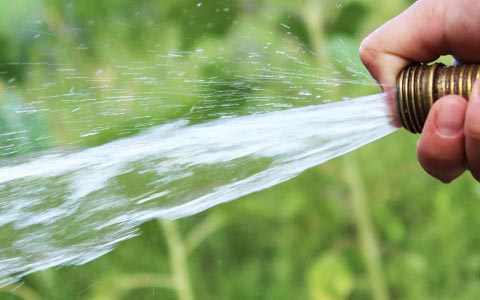
Spring tree care and maintenance watering for increased health

Out of everything a tree requires for healthy growth, water is the most important. Too little, and the tree will suffer hydraulic failure. Too much, and roots may become diseased, quickly killing the tree. Take the following into account:

• Soil around the tree should be well-drained (doesn’t pool up and stay)
• Soil should be consistently moist to the touch (not wet)
• Avoid all overhead watering or practices that splash water (splashing water is a primary vector for disease transmission)
• Water your tree 2 to 3 times per week
• Deep water your tree once weekly (let the water soak to a depth of 12 to 15-inches, this encourages roots to grow deep)
• Use soaker hoses or buckets to irrigate your trees (buckets with holes drilled in the bottom are great for deep waterings)

Tip: Increase watering frequency during times of drought and decrease it in unusually wet times.

4. Mulch Your Trees and Gardens
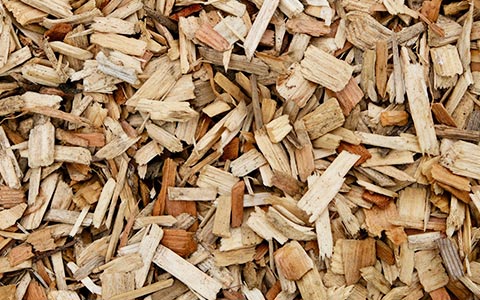
Spring tree care and maintenance mulch to regulate soil moisture and temperature

Applying organic mulch to your trees and garden helps regulate both soil temperature and moisture. Here’s how to do it right:

• Apply a 3 to 6-inch layer of mulch to the entire area within the dripline of your trees (needles, wood chips, or compost)
• Keep mulch pulled back 2 to 3-inches from the tree trunk (this avoids excess moisture and insect trouble around the root flare)
• When the mulch compresses, fluff it up and add more when needed
• Mulch your garden in the same manner

Mulch also serves as an “off-limits” zone to keep lawnmowers, wheelbarrows, and other equipment from encroaching on and damaging your trees.

Note: The drip line is the area beneath the branches, extending to the outer edge of the canopy.

Tip: Organic mulch naturally adds nutrients to your soil as it decomposes while increasing and protecting your soil’s biodiversity.

5. Fertilize Trees and Plants

http://www.72tree.com/wp-content/uploads/spring-tree-fertilizer.jpg

You may need to feed your trees. Before doing so, you should have your soil properly tested to measure its nutrient and mineral content, as well as its pH. You can send your soil sample to a university extension lab or a professional laboratory. Your soil test results should reveal:

• Cation Exchange Capacity or CEC (measures soil’s ability to retain elements and nutrients with positive charges or “cations”)
• Base Saturation (this is the distribution of cations in the soil)
• Nutrient and mineral levels and deficiencies
• Soil pH (most trees prefer slightly acidic soil or a pH of 6.1 to 6.9)

What increases soil pH? Lime can be added to acid soils to increase soil pH. Lime not only replaces hydrogen ions while increasing soil pH, it also provides calcium and magnesium to the soil.

What decreases soil pH? Aluminum sulfate and sulfur are commonly used to acidify soil. Easily found at garden supply centers, aluminum sulfate changes soil pH instantly as the aluminum dissolves in the soil.

What do the three numbers on fertilizer labels mean? All fertilizer labels have three bold numbers. The 1st is the nitrogen (N) content, the 2nd is the phosphate (P2O5) content, and the 3rd is the potash (K2O) content.

Fertilizers come in a multitude of combinations and types. Most popular are granular, slow-release fertilizers, which should include the components your soil test identified as deficient for optimum tree growth.

Note: Fertilizing without testing may be detrimental to your trees and shrubs. Too much nitrogen, sulfur, or magnesium may stunt tree growth and disrupt the soil’s biodiversity.

Tip: If you aren’t sure about which laboratory to send your soil sample(s), ask your local ISA certified arborist to have the soil tested for you or ask a nearby nursery which one(s) they use.

6. Remove Weeds from Your Landscape

Spring tree care and maintenance weed removal

While there are dozens of chemical herbicides promising miraculous weed control results, you run the risk of causing damage to or outright killing your plants, shrubs, and trees. Consider the following removal methods:

Stop digging! – Weed seeds are practically everywhere, but only seeds at the top of soil get the right conditions to trigger germination. Digging and cultivating activities elevate buried weed seeds to the surface. Dig only when needed and immediately fill the disturbed area with plants or mulch.

Mulch – Mulch regulates soil temperature and deprives weeds of sunlight. Organic mulches can host crickets and carabid beetles, which consume weed seeds.

Deadheading – Cutting back the tops of perennial weeds reduces reseeding and forces them to use up their nutrients. No matter how you choose to deadhead your weeds, chopping them down before they seed will help you keep them from spreading.

Water your plants, not your weeds – Deprive weeds of water by placing drip or soaker hoses underneath the mulch. This method efficiently irrigates plants and leaves nearby weeds dry. Water depriving weeds can reduce weed-seed germination by up to 70 percent.

Pull them out – After rain or a deep watering, get your gloves, a kneeling pad, and a weed disposal container. Use a fishtail weeder or an old salad fork to pry up tap-root weeds, like dandelion, thistle, and dock. During dry conditions, weeds sliced off just below the soil line will die. If your weeder is too large or wide, use an old steak knife to sever their roots, then fill in any open spaces left in your mulch.

Note: Keeping your soil’s biodiversity healthy and maintaining a minimum of 3-inches of organic mulch year round will naturally deter weed growth.

7. Plant New Trees

Early spring is a great time to plant a tree. Both evergreens and deciduous trees will be coming into their growing season and have the time to “harden” new growth before the arrival of the next winter season. Observe the following:

• Determine the proper tree species by your USDA hardiness zone map
• Determine which species is the right tree in the right location
• Have the soil tested and adjusted to the species preferences
• Plant your tree
• Care for your tree

Read this beginners guide to tree planting to learn more about the process and considerations.

Spring tree care and maintenance planting new trees

Spring Trees

In this article, you discovered seven pro tips to guide you through your tree preparation for the coming growing season.

With just a little knowledge about tree care and easy-to-follow tips, you can all but guarantee a healthy and robust growing season.

Ignoring the basic necessities of your trees will lead to their disease, infestation, decline, and eventual death. Allowing your trees to die in this manner invites the potential for cataclysmic property damage and personal injury when they fall.

Sources:
esf.edu/pubprog/brochure/soilph/soilph.htm
extension.umn.edu/planting-and-growing-guides/watering-established-trees-and-shrubs
extension.umd.edu/hgic/topics/fertilizing-trees-and-shrubs
hgic.clemson.edu/factsheet/changing-the-ph-of-your-soil/
extension.purdue.edu/extmedia/fnr/fnr-506-w.pdf

This article was first published on: http://www.72tree.com/spring-tree-care-tips/

Thursday, February 18, 2021

What To Do with a Tree Stump

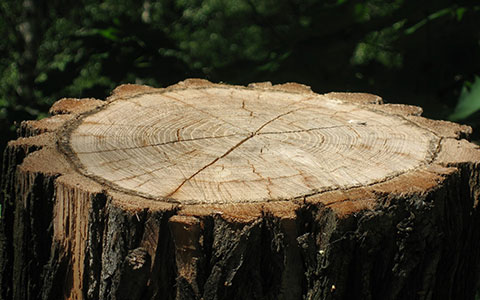
Tree stump freshly cut

Prevent losing the opportunity to repurpose your tree stump. Once you have your dying or dead tree removed, leave the stump and transform it into something special.

72tree.com gathered information on what you can do with a tree stump after having the tree removed.

Tree Stump Repurposing and Decor Ideas

When it’s time to cut down your tree, you’ll want to think ahead and determine what to do with the stump. You could have it ground down or removed by the tree service, or you could preserve and repurpose it in your yard. Consider the following:

• How tall of a stump do you want to keep?
• If you are planning to landscape or hardscape, will the stump interfere with or complement your project?

Here are ten ways to creatively repurpose your tree stump:

1 – Plant a Tree in Your Tree Stump

Tree planted in stump

This may seem odd, but when your stump begins to decay in the center, you can plant a sapling or robust outdoors plant right in the stump. Simply cover the roots with nutrient-rich compost and silty soil, water two to three times per week.

This would most likely work best in a stump cut within one to two-feet of the ground. Taller stumps would work for climbing or crawling plants.

2 – Tree Stump Plant Pedestal

Potted plants displayed on tree stump

Showcase your favorite potted plants by placing them atop the stump. You can also use your stump as a location for your indoor plants to get some sun.

The stump height for this use would depend on your preference. The cut across the stump should be as level as possible for maximum stability.

3 – Tree Stump Statue Pedestal

Tree stump used as a statue pedestal

One way to give your garden statue a more organic look is to use your tree stump as its pedestal. You can complement your statue with surrounding plants or climbing vines.

The stump height for this idea will depend on the statue’s weight and your ability to anchor it to the stump. The statue’s stability will also depend on a level cut across the stump.

4 – Tree Stump Backyard Art

Tree stump used to display art in backyard

Your tree stump can be used to display letters, trinkets, figurines, or any outdoor collectibles. You could even place some lawn chairs around the stump and serve up some tea.

The stump height for this use will depend on what you intend to display and how within reach you want it.

5 – Tree Stump Carving Art

Artwork carved into tree stump

If you’re into carving, a tree stump will offer you a “blank canvas” and a chance to show off your creative skills.

Stump height for this project depends on what you plan to carve.

6 – Tree Stump Large Shapes

Large shapes carved out of tree stumps

In addition to carving artwork into a tree stump, you can use the whole stump to carve or cut out large objects like a giant Christmas ornament or an oversized mushroom.

Stump height for this project depends on what you plan to create.

7 – Tree Stump Chair

Seat made from a tree stump

Depending on the stump’s location and diameter, you might benefit from transforming it into a chair.

The stump height for this idea depends on how tall you want the back of the chair to be.

8 – Tree Stump Chopping Block

Tree stump left in place used as a chopping block

Both useful and somewhat ironic, you could turn your tree stump into a chopping block, giving you a sturdy surface to split logs for a wood-burning stove or fireplace.

The ideal height for a tree stump used as a chopping block is between twelve and sixteen inches.

9 – Tall Tree Stump Caricatures

Tree stump carved into statue

Create striking imagery when you have a life-size or larger-than-life caricature carved into your stump, overlooking your yard. If you ever move, cut the stump at ground-level and take your masterpiece with you.

Stump height for this project depends on how tall you want the caricature.

10 – Let Your Stump Decay

Tree stump allowed to decay naturally

If you enjoy seeing the decay process and the different flora and fauna it attracts, your tree stump will be the gift that keeps on giving. You can start or accelerate the decay process by drilling wide holes deep in the stump, filling them with water, and a high-nutrient-content fertilizer.

Stump height for this is at your discretion.

Tree Stump Removal

In some cases, keeping your tree stump after tree removal may not be in your best interest. Take these scenarios, for example:

• If the tree’s roots were buckling your driveway, you may want the stump removed to guarantee root death.
• If your tree is being removed due to severe vascular diseases like oak wilt or anthracnose, keeping the stump may help spread and perpetuate the disease in nearby trees.
• If your tree suffered catastrophic damages from a boring insect infestation, stump removal may be required to prevent subsequent tree infestations.

If you decide to manually remove your tree stump, read How To Remove a Tree Stump Without a Grinder.

Giving a Tree Stump New Life

In this article, you discovered multiple ways to keep and repurpose a tree stump after the tree has been removed.

By keeping your tree stump after tree removal, you gain an opportunity to express your artistic and design-savvy by creating a useful structure or attractive showpiece.

Removing the stump after felling your tree strips you of the opportunity to create something unique with years of durability.

Sources:
ucanr.edu/blogs/blogcore/postdetail.cfm?postnum=11441
munews.mansfield.edu/?p=757
s3.wp.wsu.edu/uploads/sites/2073/2014/03/Landscaping-with-Dead-Trees.pdf

This article was first published on: http://www.72tree.com/what-to-do-with-a-tree-stump/

Friday, January 22, 2021

Tree Diseases on Bark

Canker disease swelling and girdling tree trunk

Prevent diseases on your tree’s bark from killing it. Knowing what type of disease is growing on or in your tree will help you take appropriate measures to treat it.

72tree.com gathered information on diseases that affect or appear on tree bark, how severe they are, and what actions are needed to prevent the disease from spreading.

Tree Bark Diseases

Tree bark completely covers a tree’s trunk, branches, stems, and twigs. It could be seen as a protective skin that repels insect infestations, shields against pathogens, and resists physical damage. Frequently, however, a stressed tree will likely develop one of the following:

Cankers on Trees

Cankers are dead areas of bark on a tree’s trunk or branch. Multiple factors can cause bark death, like damage caused by an impact, bacteria, or fungi. Pathogens such as bacteria or fungi are usually unable to penetrate healthy bark, but if the tree is stressed or the bark is damaged, infection is more likely. Consider the following types of cankers:

Wound Canker – These cankers, sometimes referred to as annual cankers, are most common at or near the base of a tree. They are typically caused by a lawnmower, vehicle, and/or maintenance equipment strikes or repeated abrasion.

Cankers resulting from impact wounds are severe threats that need to be prevented. Allowing conditions for these wounds to persist can result in the girdling and death of the tree.

Prevention: Create a safety zone using organic mulch or gravel around the tree.

Tip: Existing wounds should be carefully trimmed (without widening or deepening the wound), so the tree can properly seal the wound. Point out these wounds/repairs to your tree professional.

Perennial Canker or Cytospora Canker (Target-Shaped) – This canker is one of the more common diseases of shade and fruit trees. It is caused by one of several Cytospora fungi (Nectria, Strumella, Eutypella, etc.) and attacks multiple hosts, including:

• Apple (Malus domestica)
• Apricot (Prunus armeniaca)
• Ash (Fraxinus)
• Aspen (Populus tremuloides)
• Birch (Betula)
• Beeches (Fagus)
• Cherry (Prunus avium)
• Elm (Ulmus)
• Hickories (Carya)
• Maples (Acer)
• Peach (Prunus persica)
• Poplars (Populus)
• Walnuts (Juglans)
• Willow (Salix)

Cytospora infections can occur via bark wounds, at junctions of dead and live branches, or at poorly cut pruning wounds. The fungi slowly grow through bark during the tree’s dormancy (late fall and winter). Then, in the growing season, the host trees respond by compartmentalizing the affected areas. This alternating growth of the fungus and the tree forms a distinct elongated, target-like appearance.

Identification: These cankers will appear sunken on branches or trunks and present the following:

• Colors vary from off-brown to gray shades
• Black fungal structures (pycnidia) embedded in small bumps around the wound
• Brownish to orangish masses of spores being extruded from pycnidia
• Oozing sap and/or a wet appearance

Tip: These cankers slowly expand over time and can eventually girdle the branch or the whole tree (when located on the trunk). Ask a professional tree service to evaluate your tree and recommend a course of action.

Diffuse Canker – With these highly lethal cankers, necrosis spreads so quickly that the host can’t compartmentalize the area fast enough to stop its progression. The differences between these and other cankers are:

Necrotic diffuse canker on tree trunk killing bark

• No callus rings are formed, the affected area appears dark, sunken, and often moist
• Diffuse cankers continue expanding during the growing season
• When these cankers occur on a tree’s trunk, the tree will likely die

Some of the pathogens responsible for diffuse cankers are:

• Phytophthora dieback
• Cytospora canker
• Botryosphaeria canker
• Hypoxylon canker
• Chestnut blight

Identification: Diffuse cankers appear as sunken, dark areas similar to other cankers, but with no callus rings. It is common to see sap oozing from these cankers.

Note: Diffuse cankers move fast enough to completely girdle and kill their hosts in a single growing season.

Managing Pathogen-Driven Canker Diseases – As with nearly all tree problems, prevention is easier and less costly than treatment. Consider the following:

• Properly prune your tree (only in dry weather)
• Sanitize all pruning equipment with 10% bleach or 70% alcohol before and after each tree
• Remove and destroy any dead or infected material
• Prevent tree wounds (mechanical and environmental)
• Soil should be well-drained
• Improve tree health (water, fertilize, prune, and mulch)
• Apply a preventative chemical treatment to un-infected trees

Tip: Have your trees inspected annually by a professional tree service. Besides early detection of disease, you may identify other stressors that increase your tree’s susceptibility to developing cankers.

Mushrooms on Tree Bark

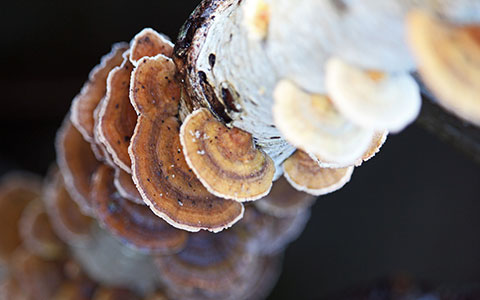
When you see mushrooms growing on a tree, be concerned. Mushrooms are the fruiting structures of fungi. For them to appear, the fungi must be well-developed and have caused extensive decay within the tree. Consider the following:

Mushrooms on a Tree Branch – Carefully prune the branch from the tree and destroy (burn) it. Avoid spreading pathogens from one tree to the next by sanitizing your equipment with 10% bleach or 70% alcohol before and after working on infected trees.

After removing all visibly affected limbs or branches, monitor your tree over the next growing season and have it thoroughly inspected for any other potential issues (decay-causing fungi can quickly spread throughout a tree).

Mushrooms on a Tree Trunk – Call a professional tree service as quickly as possible. Your tree’s trunk is likely suffering from extensive internal decay and needs removal.

Mushrooms growing through birch tree bark signaling internal decay

Mushrooms on a Tree’s Root Flare – Again, this is an urgent scenario. When mushrooms grow from the root flare, there is likely significant decay within the tree’s roots, potentially destabilizing the tree when winds and storms come through. The tree will likely require emergency removal.

Treatment: When dealing with mushrooms on your tree, you will be limited to removing affected limbs and branches. For this, prevention is easier and less costly than treatment. Consider the following:

• Properly prune your tree (3 cut method)
• Sanitize all pruning equipment with 10% bleach or 70% alcohol before and after each tree
• Remove and destroy (burn) any dead or infected material
• Prevent mechanical tree wounds
• Prepare your trees for severe weather events
• Soil should be well-drained to avoid root rot
• Improve tree health (water, fertilize, prune, and mulch)
• Apply a preventative chemical treatment to un-infected trees

Tip: Avoid disturbing these mushrooms. Trying to remove them can release billions of microscopic spores into the air, potentially spreading the disease to other trees, shrubs, and plants.

Tree Diseases

In this article, you discovered information about the diseases that affect and appear on tree bark, the damage they cause, and how to prevent them.

By taking swift action to treat or remove a diseased tree, you are protecting your property and surrounding trees.

When you ignore diseases appearing on tree bark, you risk the sudden death or destabilization of the tree and the expensive damages it can cause when it falls.

Sources:
uaex.edu/environment-nature/forestry/health/treecankers.pdf
extension.usu.edu/pests/ipm/notes_ag/fruit-cytospora
extension.colostate.edu/topic-areas/yard-garden/cytospora-canker-2-937/

This article was first published on: http://www.72tree.com/tree-diseases-on-bark/

Tuesday, December 15, 2020

Tree Root Rot Causes, Symptoms, and Treatments

Root rot disease causes and identification

Don’t let root rot cause your trees to suddenly decline, die, and fall. Knowing how to identify root rot symptoms will help you save your tree or take action before it causes catastrophic property damages.

72tree.com gathered information on the causes of root rot in trees, how to recognize its symptoms, and what treatments you can use to stop or prevent it.

Tree Root Rot Causes

When root rot attacks a tree, the flow of water and nutrients from the roots to the crown is either impeded, or the invading pathogen is carried throughout the tree, killing its host. The following are several of those pathogens:

Rhizoctonia (this fungal pathogen adversely affects younger hosts, older trees are found to be more resistant)

Pythium (this fungus of the Pythiaceae family has 140 known species, most of which are now classified as parasites)

Rhododendron Root Rot (Phytophthora cactorum and Phytophthora cinnamomi were first thought to only survive in subtropical countries but is now known to thrive in cooler countries)

Fusarium (found worldwide, some of this pathogen’s species can adversely affect humans when infected crops are consumed)

Rosellinia necatrix (Dematophora necatrix, Hypoxylon necatrix, and Pleurographium necator, known as one of the most devastating plant fungal diseases, affecting several fruit tree and crop species)

Honey Fungi, Shoestring Root Rot, or Openky (Armillaria frequently occurs in hardwoods and pines)

Texas Root Rot (Phymatotrichopsis, Phymatotrichum, Cotton, or Ozonium root rot occurs more frequently in Mexico and the southwestern United States, causing sudden wilt and death)

Note: Fungal spores naturally occur and lie dormant in soil. These spores only begin reproducing when conditions support it. Such conditions include compacted soil, poorly-drained soil, and overwatering. As the fungi reproduce, tree roots provide a prime source of nutrients, allowing them to spread quickly.

Symptoms of Tree Root Rot

Root rot disease symptoms and treatment

Most visible symptoms of root rot strikingly resemble the signs of an advanced pest infestation, making an accurate diagnosis more difficult. The most common, above ground, symptoms of root rot include:

• Gradual or sudden decline without a detectible reason
• Severely stunted or poor growth patterns
• Smaller, chlorotic leaves or needles (new growth)
• Wilted, yellowed, or browned leaves or needles
• Dieback
• Severe canopy thinning
• Stress crops (abnormally large amount of fruit/seeds)
• Fungal fruiting structures (mushrooms) found on the root flare or growing from surface roots
• Once in the xylem and phloem (cambium), cankers or sunken dead areas may appear on branches or the trunk of the host

A more accurate way to diagnose root rot is to dig to the roots to see if decay is present. Care should be taken when exposing roots to avoid inflicting further harm to the tree.

Note: Anthracnose is another group of fungal pathogens that cause similar above-ground tree damage but are not typically associated with root rot. You can find further information about anthracnose at 72tree.com/symptoms-of-anthracnose/

Tip: Hire an ISA certified arborist to inspect and accurately diagnose the cause(s) of the symptoms you have identified.

Tree Root Rot Treatment

Trees can sometimes be saved early on by pruning out infected roots. If a tree is in an advanced state of decline, the recommended way to control root rot diseases from spreading is to entirely remove it.

Chemical treatments that include propiconazole, chloropicrin, fosetyl-aluminum, or methyl bromide, among others, won’t completely cure or remove the disease but can reduce the infection level. These treatments are applied in and around the root plate of infected trees and especially in holes left after infected trees, and their stumps have been removed.

Note: The application of chemical treatments on your trees (for any reason) should be performed as directed on the product labeling and closely monitored by a certified arborist.

Root Rot Prevention for Trees

Root rot disease protection for surface roots soil and overwatering

Trees have adapted over millennia to protect themselves against infection and illness. They are efficient at protecting themselves when healthy, and you can further assist them in resisting root rot by:

• Avoiding overwatering
• Ensuring proper water drainage by amending/enriching soil structure
• Preventing soil compaction on or around the root plate
• Protecting surface roots and trunks from mechanical and/or equipment damage
• Immediately addressing storm damage and/or soil erosion
• Removing unsalvageable trees from your property
• Planting disease-resistant species

Tip: You can also help trees fight fungal attacks by promoting their health. These are some of the things you can do to improve their health:

• Seasonal pruning
• Seasonally applying and refreshing organic mulch
• Deep watering (especially during drought conditions)
• Pre-growing season fertilization
• Annual tree inspections by a certified arborist

Note: The importance of annual tree inspections cannot be overstated. The ability to detect problems in their beginning stages offers more options to eliminate existing problems and take measures to prevent issues throughout the tree’s growing season.

Tree Root Rot

In this article, you discovered valuable information about the causes of tree root rot, recognizing its symptoms, and how to treat it or prevent it.

Taking swift action when root rot is suspected in your trees will increase your chances of saving them and preventing further infection.

Ignoring the signs of root rot will render your tree unsalvageable, invite other disease and infestation, and potentially cause catastrophic property damage when your tree destabilizes and falls.

Sources:
extension.umd.edu/hgic/topics/root-rots-trees-and-shrubs
ceventura.ucanr.edu/Com_Ag/Subtropical/Avocado_Handbook/Diseases/Root_rot,_how_to_spot_it_and_what_to_do_about_it/
forestpathology.org/root-diseases/
extension.psu.edu/rhizoctonia
hyg.ipm.illinois.edu/pastpest/199922c.html

This article was first published on: http://www.72tree.com/tree-root-rot-causes-symptoms-treatments/

Wednesday, November 18, 2020

Kudzu Vines Killing Trees

Kudzu out competes everything from grass to plants and even mature healthy trees

Keep your trees from being engulfed and killed by invasive kudzu vines. Knowing how to stop and control kudzu vines will help you save your trees, shrubs, and plants.

72tree.com assembled the following information about kudzu vines to help you understand their destructive nature and keep them from causing catastrophic damages to your trees.

Kudzu Vines and Trees

Kudzu vines can trail or climb. When they climb trees, they practically glue themselves to the bark of their host as they climb. Once breaching the canopy, the vine spreads rapidly, causing extreme shading of the tree.

If the affected tree doesn’t decline from girdling, it will certainly die once the vine completely overshadows the canopy unless immediate action is taken.

How To Safely Remove Kudzu from a Tree – The following steps will help you stop kudzu vines from killing your trees.

• Locate and cut the vine’s lower-most growth at the base of the tree
• Apply a 50% solution of triclopyr to the vine’s stumps to kill the roots
• Let the vine die on the tree. Pulling it off may cause severe bark damage.

Tip: Persistent weeding, mowing, and/or grazing (especially during the growing season) will deter the vine from reestablishing itself.

Kudzu Invasive Species

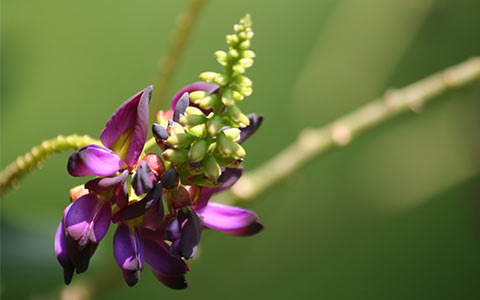
Kudzu (Pueraria montana var. lobata) vines are fast-growing, woody, hairy, trailing, or climbing vines that can grow to lengths of 100 feet with a massive taproot. The vine has large compound leaves with three broad leaflets. The plant bears long flower clusters of late-blooming reddish to purple flowers and brown, hairy, flattened seed pods.

Kudzu flowers are late blooming red to purple clusters that yield flattened seed pods

Introduction to the US – Kudzu, native to Asia, was introduced to the United States in the late 1800s as a means of erosion control, livestock forage, and ornamental purposes (introduction occurred in 1876 at the Philadelphia Centennial Exposition where it was exhibited as an ornamental vine).

Plant Reproduction – Kudzu’s spread is primarily vegetative by taking root at nodes where the vines contact soil and subsequently form entirely new plants. The plant can also spread by seed, but few viable seeds are found in each pod.

Plant Growth and Habitat – Pueraria montana grows well in multiple habitats and soil types. Its most aggressive growth rate occurs where winters are mild, average summer temperatures are above 80°F, and annual rainfall reaches or surpasses 40 inches. However, the plant’s robust root system helps it survive summer or extended drought conditions. In areas where the plant successfully establishes itself, it can be found in abundance along roadsides, old/abandoned fields, forest edges, and other sunny areas.

Since its introduction, kudzu has spread fervently. It is currently present from New York to Florida and from nearly the entire eastern seaboard as far west as Arizona (Oregon and Washington have also reported confined cases of the species).

USDA Classification – In 1953, the United States Department of Agriculture (USDA) removed this plant species from its list of allowable cover plants. Then in 1970, kudzu was listed as a common weed of the South.

Note: By growing up to 12 inches per day, this invasive species can out-compete and kill everything from grasses to mature trees, crowding and shading them.

Kudzu vines overgrowing trees

Kudzu Control and Prevention

Effective control methods of Pueraria montana depend on the size and location of the infestation. Consider the following:

Small or Poorly-Established Patches – These can usually be eliminated by repeated weeding, mowing, and/or grazing during the growing season.

Large or Well-Established Infestations – While weeding, mowing, and/or grazing effectively slow this type of infestation, it will typically not kill the roots of the larger plants.

These infestations can also be controlled with a foliar solution of 2% to 3% glyphosate or triclopyr plus a 0.5% non-ionic surfactant to thoroughly wet all the leaves.

After surface vegetation is controlled, you can dig and cut into the central root system and apply a 50% solution of glyphosate or triclopyr to the wounded roots.

When an infestation encroaches on desired vegetation, avoid using chemical control methods and manually remove the plant(s).

Tip: All treatments should be monitored for multiple growing seasons to prevent re-sprouting.

Advisory: When using any herbicide or pesticide, follow all directions/instructions on the label. “The label is the law!”

Kudzu (Pueraria montana var. lobata)

In this article, you discovered essential information about kudzu vines, how to stop them from killing your trees, and how to eliminate them altogether.

By taking swift action to control this highly invasive plant species, you can prevent your trees and landscape from being over-grown and snuffed out.

When you ignore a kudzu infestation, you are potentially signing a death warrant for all vegetation in its path, ranging from grasses to mature, healthy trees.

Sources:
ncforestservice.gov/publications/Forestry%20Leaflets/IS08.pdf
invasivespeciesinfo.gov/terrestrial/plants/kudzu
invasive.org/browse/subthumb.cfm?sub=2425&start=1
eddmaps.org/distribution/usstate.cfm?sub=2425
npgsweb.ars-grin.gov/gringlobal/taxon/taxonomydetail?id=314966

This article was first published on: http://www.72tree.com/kudzu-vines/

Tuesday, October 20, 2020

Why Do Trees Die

Trees dying from hydraulic failure

Prevent the environment, disease, and insect activity from killing your trees. Knowing why trees die will help you take notice and intervene on threats to your tree’s life.

72tree.com assembled the following information about the many factors that lead to the death of trees, the signs and symptoms of a dying tree, and what to do about it.

1. Tree Diseases

Tree diseases can wreak havoc on your trees, and in some instances, kill them in a single growing season. The following are some of the more common diseases that infect trees:

• Anthracnose (Glomerella cingulata)
• Fire Blight (Erwinia amylovora)
• Diplodia Tip Blight (Sphaeropsis sapinea)
• Oak Wilt (Ceratocystis fagacearum)
• Dutch Elm Disease (Ophiostoma ulmi)
• Canker Diseases (caused by multiple fungal pathogens)

Signs and Symptoms – Trees infected with different diseases will display different symptoms. However, all should be treated with haste to prevent the decline and death of the infected tree. The following symptoms can help you diagnose the disease you are dealing with

Anthracnose – Sunken spots or lesions of various colors in foliage, stems, fruit, and/or flowers. Some infections lead to cankers on twigs, branches, and trunk.

Treatment – If this disease is caught early enough, extensive pruning may halt its progression, allowing the tree to compartmentalize affected areas.

Read more about anthracnose at 72tree.com/symptoms-of-anthracnose/

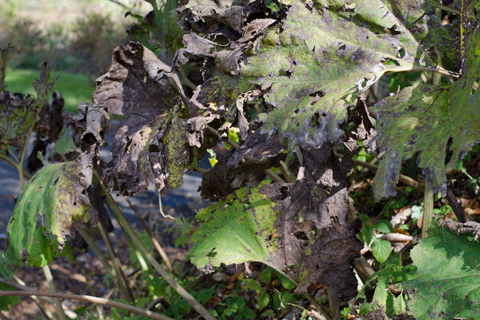
Fire Blight – Sudden brownish-black withering and death of blossoms, leaves, twigs, fruit spurs, and branches are signs of this disease. Heavily affected trees will appear scorched by fire and may die altogether.

Leaves infected and blackened by fire blight

Treatment – Extensive pruning of affected areas and copper fungicides. However, there is no cure for fire blight. Removal of the tree should be considered before the pathogen spreads to neighboring trees and shrubs.

Further reading on fire blight can be found at 72tree.com/preventing-fire-blight-tree-disease/

Diplodia Tip Blight – This disease infects conifers, first killing needles at the tips of branches. Symptoms typically appear on the lower half of the tree, progressing upwards. When new needles begin expanding, they end up stunted, turn yellow, then tan or brown.

Treatment – This pathogen responds to fungicide treatments. Treatment should start at bud break in the spring for effective control. Pruning out damaged areas, and cones should also be removed, as they hold fungal spores.

This blight can be controlled, but not cured. As with any needle blight disease, the objective of spraying the tree is to break the cycle of infection in emerging needles. Many seasons of treatments are needed before noticeable results are achieved.

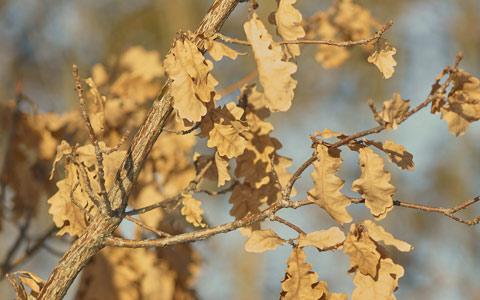
Oak Wilt – This disease infects oak trees. It can be identified as mature foliage develops a dark green water-soaked appearance, or may turn pale green or bronze, starting at the leaf margins and progressing toward the center of the leaf. This usually begins on a single branch and quickly spreads throughout the entire crown. Red oaks can die within 4 to 6 weeks after symptoms appear.

Dead leaves on tree with Bretziella fagacearum oak wilt disease

Treatment – Once an oak tree is infected with oak wilt, there is no known treatment capable of ridding the tree of the disease. Infected trees should be professionally removed.

Note: Healthy oaks can be injected with a fungicide known as Propiconazole to suppress oak wilt disease. Since Oak Wilt is spread by root grafts and insect carriers, treat those trees close to infected ones to slow the disease’s spread.

For more oak wilt information, visit 72tree.com/oak-wilt-identification-treatment-prevention/

Dutch Elm Disease (DED) – DED is a vascular wilt disease in trees. External symptoms of infection are yellowing and wilting of leaves on individual branches. These leaves then turn brown and curl up as the branch dies, foliage eventually may drop off.

Treatment – Much like oak wilt, Dutch Elm Disease must be treated proactively before the disease is present in the tree. This disease spreads so quickly that diseased trees may not respond to any form of treatment.

Note: Healthy elms can be professionally treated in the same manner as healthy oaks with the Propiconazole fungicide.

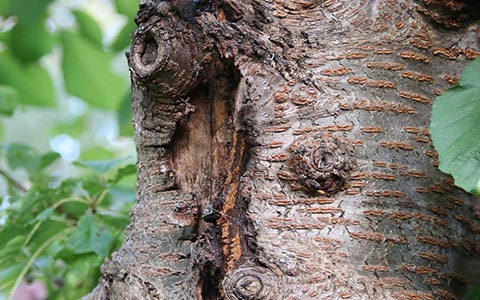
Canker Diseases – Symptoms may include round-to-irregular sunken, swollen, flattened, cracked, discolored, or dead areas (appearing as bruises or open wounds) on tree stems, twigs, limbs, or trunk.

Canker from tree fungi on tree trunks and branches

Treatment – There is no cure for canker diseases on fruit and shade trees, but the disease’s spread can be controlled by pruning out infected areas. In late winter or early spring, carefully remove and destroy infected branches 4 inches below the canker where the tree is releasing amber color sap. If the canker is located on the trunk, request professional help to treat the infected area or remove the tree.

When treating, pruning, or interacting with diseased trees, you can reduce the chances of spreading the disease by:

• Sanitizing all equipment, including gloves, rakes, saws, etc. before and after use
• Destroying (burning) dropped or pruned foliage, twigs, and limbs (never add infected material to compost piles)
• Never spraying infected trees with overhead watering or irrigation

When in doubt, don’t take the chance of making a bad tree situation worse. Reach out to an ISA certified arborist for professional help. Read more about tree fungi control and prevention at 72tree.com/how-to-get-rid-of-tree-fungi/

2. Weather-Related Tree Damage

Trees have spent millennia adapting to their climate and region. That said, severe weather can still inflict significant and sometimes lethal damages to a tree. For example:

Bark Stripping – During catastrophic weather events like tornadoes and hurricanes, bark can be stripped from a side of or from the entire tree, effectively killing it.

Impact Damage – Also, during severe weather events, yard ornaments, statues, bicycles, and even vehicles can be carried by wind or floodwater, impacting and severely damaging the tree’s bark. If enough bark is damaged or stripped from the tree, it will be girdled and quickly die.

Drought – When the weather is dry, trees still need water. Most tree roots live within the first 30-inches of soil, and without water for prolonged periods, a tree can suffer hydraulic failure and die. Proper mulching and increased watering patterns can prevent this peril.

Severe or Repeated Flooding – In contrast to drought, this can lead to the destabilization of a tree’s root plate. When this condition occurs, the tree may develop a lean or suffer windthrow from the slightest wind.

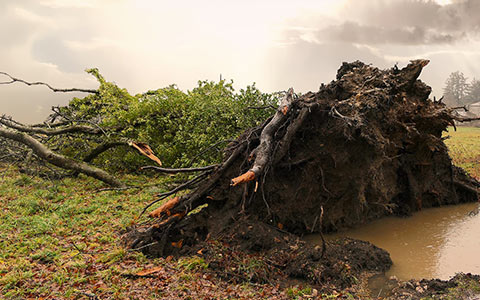
Windthrow – This condition occurs when trees are toppled by wind. When windthrow occurs, a tree is uprooted as it is blown over.

Severe weather can uproot and knock trees over this is known as windthrow one of many ways blowdown occurs

Windsnap – This condition also occurs when trees are toppled by wind. When windsnap occurs, a tree is broken off at the trunk as it is blown down. Proper seasonal pruning activities and crown thinning can significantly reduce the potential for windthrow or windsnap.

For further reading and preventative measures on windthrow and windsnap, read 72tree.com/blowndown-windthrow-windsnap/

3. Boring Insect Infestations

When it comes to tree killers, boring insects are perhaps the most prolific and persistent. Larvae feed in galleries beneath the bark, consuming the tree’s cambium layer, while adults consume the host’s foliage. Aerial views of forested land demonstrate (in large swaths) the devastation these insects are capable of. A boring insect infestation can be identified as follows:

• Adults found in traps (visual confirmation)
• Partially consumed foliage (Leaf notches)
• Chlorosis of foliage in sections of the crown
• Extreme dieback of foliage and stems
• Frass (sawdust) found on the bark from burrowing activities
• Exit holes in tree bark
• Bulging or vertical splits in the bark (over larval galleries)
• Suckers and water sprouts growing in the crown, on the trunk, and/or from the roots
• Woodpecker damage (woodpeckers hunt beetle larvae)
• Squirrel activity (some squirrel species feed on beetle larvae)

Agrilus planipennis emerald ash borer eab boring insect

As larvae feed season after season, they channel through their host’s cambium layer in a zigzag or ribbon pattern (interrupting the flow of water and nutrients. This feeding ultimately leads to a partial or total girdling of the host, resulting in hydraulic failure and death.

Boring Insect Control and Prevention – Due to the larvae’s occult feeding activities, preventing a wood-boring insect infestation is not always possible. However, these practices will help reduce the potential of an infestation:

• Plant well-adapted species of trees not commonly attacked by wood borers in your region.
• Choose and prepare a suitable planting site to avoid tree stress like freeze damage, sunscald, windburn, and other natural stressors.
• Promote your tree’s health with proper watering, mulching, and fertilization methods.
• Use proper seasonal pruning practices (winter/dormant season).
• Avoid mechanical injury to tree trunks from lawnmowers and/or construction.

If you detect a wood-boring insect infestation, contact an ISA certified arborist to not only confirm the infestation but to mobilize local and regional forestry support if needed. Such infestations can cause catastrophic damages in very little time.

Note: In the absence of stressed or ailing trees, boring insects will attack healthy specimens.

Read more exciting literature about boring insects by visiting 72tree.com/metallic-wood-boring-beetles/

4. Lifespan of Trees

While rare, a tree can die of “old age.” However, what is considered old age for one species may be merely infancy for another. Consider the following species and their average lifespan:

• Willow (Salix) 30 years
• Birch (Betula) 40 – 50 years
• Poplar (Populus) 50 years
• Magnolia (Magnolia) 80 – 120 years
• Maple (Acer) 100 – 300 years
• Oak (Quercus) 100 – 300 years
• Ash (Fraxinus) 120 – 300 years
• Aspen (Populus tremuloides) 150 – 200 years
• Walnut (Juglans) 150 to 250 years
• Fig (Ficus carica) 200 years
• Spruce (Picea) 200 years
• Beech (Fagus) 300 – 400 years
• Elm (Ulmus) 300 years
• Pecan (Carya illinoinensis) 300 years
• Pistachio (Pistacia vera) 300 years
• Giant Sequoia (Sequoiadendron giganteum) 500 – 2,000 years
• Sycamore (Platanus occidentalis) 600 years
• Bristlecone (Balfourianae) 5,000+ years

Signs and Symptoms – Trees in decline due to age may present many symptoms, including the following:

• Chlorosis (loss of color in foliage)
• Extreme dieback (multiple dead branches)
• Cladoptosis (randomly falling branches)
• Sudden Death (the tree just dies)

When a tree reaches or surpasses its lifespan it may die

If you have a tree that is nearing or surpassing its lifespan and is in decline, there is little to nothing you can do to save it. When in these circumstances, call on an ISA certified arborist’s expertise to evaluate the tree and recommend a course of action.

Note: While most tree species can outlive a human being, the vast majority of trees succumb to weather, biological, or human interference factors long before reaching their full lifespan.

Saving Dying Trees

In this article, you discovered information about the lifespan of trees, diseases, weather, and insects that are commonly responsible for why trees die.

By taking preventative measures to halt the spread of disease and insect infestations, you are helping your tree to live up to or surpass its lifespan.

When you ignore the warning signs of a dying or sick tree, you risk suffering grave consequences when that tree dies and falls on your property.

Sources:
extension.umn.edu/plant-diseases/oak-wilt-minnesota
mortonarb.org/trees-plants/tree-and-plant-advice/help-diseases/canker-diseases
ipm.ucanr.edu/PMG/PESTNOTES/pn7414.html
fs.usda.gov/naspf/sites/default/files/publications/how_to_identify_and_manage_dutch_elm_disease.pdf
plantclinic.cornell.edu/factsheets/sphaeropsisdiplodia.pdf

This article was first published on: http://www.72tree.com/why-do-trees-die/

Thursday, September 17, 2020

Metallic Wood-Boring Beetles Damaging Your Trees

Buprestidae jewel beetle with metallic golden appearance

Prevent your trees from dying when metallic wood-boring beetles infest your area. By knowing how to identify these destructive beetles, you can take action to protect and treat your trees.

72tree.com assembled the following information on metallic wood-boring beetles (jewel beetles), the damage they cause to trees, how to protect your trees, and who to call when you identify their presence.

Metallic Wood-Boring Beetles (Buprestidae) – Jewel Beetles

Jewel beetles or metallic wood-boring beetles are members of the Buprestidae family of beetles, consisting of over 15,000 known species. The larvae of this immense beetle family are known as flathead borers. These beetles possess the following traits:

Appearance – Beetles have six legs and short antennae. Nearly all adult jewel beetles will have some metallic coloration on their body. In contrast, the brightest coloration typically appears under the wing covers (elytra) or on the insect’s underside.

Size – These beetles are generally cylindrical or elongated to oval, with lengths from .12 to 3.15 in; most species are under .80in.

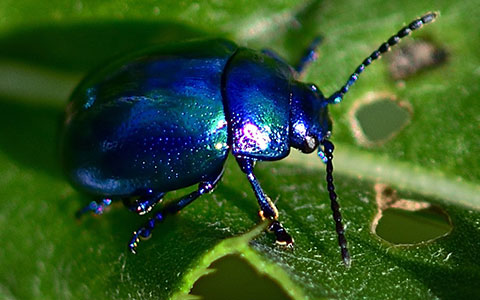
Feeding Habits – Adult beetles of the Buprestidae family feed on their host tree’s foliage, causing little damage to the tree.

The larvae of these beetles burrow through the bark, roots, and stems of multiple species of trees and woody plants to reach the cambium (water and nutrient delivery system of the tree).

Some of the more well-known jewel beetles include:

•Emerald Ash Borer (Agrilus planipennis)
•Golden Buprestid (Buprestis aurulenta)
•Bronze Birch Borer (Agrilus anxius)
•Red-legged Buprestis (Buprestis rufipes)
•Flathead Apple Tree Borer (Chrysobothris femorata)
•Anthaxia (Anthaxia)
•Oak Splendor Beetle (Agrilus biguttatus)
•Eurythyrea austriaca (Linnaeus, 1767)

Note: Scientists at the Georgia Institute of Technology in Atlanta uncovered that jewel beetle color results from light-reflecting properties of the cells comprising their external skeletons. This research suggests that a jewel beetle’s color results from its physical structure (cell alignment) rather than pigment’s light-absorbing properties.

For important information about the emerald ash borer, read 72tree.com/emerald-ash-borer-tree-damage/

Agrilus planipennis emerald ash borer eab

Metallic Wood-boring Beetle Life Cycle

As with most beetle species, their life cycle can be separated into 3 distinct phases, including:

Adult – In spring and summer, adult beetles emerge from their host and feed on its foliage while searching for a mate. Adult jewel beetles are typically short-lived, living only for a few weeks.

Egg – Females lay eggs in crevices in the bark of the same or a nearby tree.

Larva – After hatching, larvae bore into the host until reaching the nutrient-rich cambium of the host tree, where it feeds, grows, and pupates.

Most species have one generation per year or take multiple years to develop. However, some species may produce multiple generations per year.

Metallic Wood-Boring Beetle Infestation Identification

While visual confirmation of adult beetles is best, the following symptoms indicate that a metallic wood-boring beetle infestation is occurring:

•Partially consumed foliage (Leaf notches)
•Chlorosis of foliage in sections of the crown
•Dieback of foliage and stems
•Frass (sawdust) found on the bark from burrowing activities
•D-shaped exit holes in tree bark
•Bulging or vertical splits in the bark (over larval galleries)
•Suckers and water sprouts growing in the crown, on the trunk, and/or from the roots
•Woodpecker damage (woodpeckers hunt beetle larvae)
•Squirrel activity (some squirrel species feed on beetle larvae)
•Adults found in traps

Combined, the beetle’s different stages’ feeding habits will leave a tree with damaged, wilting foliage, and in rapid decline.

As larvae continue to feed, they channel through their host’s cambium layer in a zigzag or ribbon pattern. This feeding ultimately leads to a partial or total girdling of the host, resulting in hydraulic failure and death.

Buprestidae larva consuming ash tree cambium

Affected Tree Species – Some tree species especially susceptible to wood-boring beetles in the Buprestidae family include:

•Pine (Pinus)
•Spruce (Picea)
•Fir (Abies)
•Hemlock (Tsuga canadensis)
•Ash (Fraxinus)
•Beech (Fagus)
•Hazelnut (Corylus)
•Apple (Malus domestica)

Generally, Buprestidae prefer attacking trees and woody plants in decline or dying. However, a number of the species will attack “green,” flourishing specimens. An example of this is the emerald ash borer (EAB), which has decimated the ash tree population in many parts of the US and continues on the move.

Note: Many wood-boring beetle species seek, attack, and infest specific tree families like the emerald ash borer that attacks those species within the ash family.

Metallic Wood-Boring Beetle (Buprestidae) Control and Prevention

Metallic wood boring beetle adult consumes tree foliage

Due to their larvae’s hidden feeding activities, preventing a metallic wood-boring beetle infestation is not always possible. However, the following practices will help reduce the risk of an infestation:

•Select well-adapted species of trees not commonly attacked by wood borers in your area.
•Choose and prepare a suitable planting site to avoid tree stress, freeze damage, sunscald, windburn, and other stressors.
•Use proper watering and fertilization methods.
•Use proper seasonal pruning practices (winter/dormant season).
•Avoid mechanical injury to tree trunks from lawnmowers construction.

Your trees’ care includes the safe removal and destruction of infested, diseased, and dying trees from your property and surrounding areas.

Most of the time, wood-boring insects are secondary invaders (successfully attacking a tree already in decline). For a tree, the first line of defense against any infestation is to keep them healthy. Proper care of trees and woody plants discourages many borer pests. Good sap flow from healthy, vigorous trees, for example, defends the plant from damage by many borer pests.

If you have confirmed a boring insect infestation on or near your property, immediately contact an ISA certified arborist to evaluate your property’s risk and recommend a course of action.

Note: If you are inclined to use chemical treatments on your trees or as a ground soak, allow a professional to apply it. To chemically stop or prevent a boring insect infestation, such products must be applied correctly and at the right time.

Jewel Beetles (Buprestidae)

In this article, you discovered essential information about metallic wood-boring beetles, their appearance and life cycle, how to identify an infestation, and how to prevent or control these deadly beetles.

By taking swift action to prevent or control a jewel beetle infestation, you are helping all of the trees on and around your property.

When you allow a wood-boring beetle infestation to go unchecked, you can be responsible for devastating infestations spreading far beyond your property.

Sources:
texasinsects.tamu.edu/woodborer-metallic-woodboring-beetle/
extension2.missouri.edu/g7422
fs.usda.gov/Internet/FSE_DOCUMENTS/stelprdb5320268.pdf
nsf.gov/news/news_summ.jsp?cntn_id=115304

This article was first published on: http://www.72tree.com/metallic-wood-boring-beetles/