Your tree is more likely to die if you don’t consider the factors that affect its development during their planting. Your trees’ health is directly correlated to the time, location, pre-planning, and species that you choose ever before planting.
72tree.com assembled the following guide with professional tips to help you properly plant and care for your tree.
Best Time to Plant Trees
There is much debate as to when the best tree planting time is. For more moderate climates such as the south, southeast, or southwest, either early fall or early spring are appropriate planting times.
For locations where there is winter snow cover or ground freeze, spring (after the ground thaws) is the best time to plant.
Tree Location
Now that you’ve decided to plant a tree and identified the best time, you’ll need to choose a suitable location. In doing so, take the following factors into consideration:
Sunlight – Does the planting location get full sun (all day), partial sun (morning or evening), or full shade (no sun)
Water – Most tree species require well-drained soil. If your chosen location is in a low-lying area or a depression, water may accumulate and stand, leading to root rot and other diseases.
Tip: Verify that your location is well-drained after a rainstorm or run a hose at the site to see how the water accumulates or runs off.
Soil – The soil where you plant your tree should be loose, mixed with organic material, and turned to avoid compaction.
Tip: Many tree species can thrive in a soil pH level between 5 (acidic) and 7(neutral). You can raise the soil pH by adding lime or limestone and reduce the pH by adding aluminum sulfate, sulfur, manure, or compost (pH levels above 7 are alkaline).

Spacing – When planting multiple trees, they can be spaced apart according to their mature canopy spread. Tree spacings from 20 to 60 feet apart are standard. This spacing allows the open-grown form of the tree canopy to develop naturally.
Conversely, when planted too close together, a tree may fail to reach its mature height and struggle to absorb enough sunlight and nutrients to remain healthy.
Tip: Follow spacing recommendations for your specific tree species.
Wind – The location you’ve selected should be observed over time to determine whether or not your tree will endure constant wind or violent wind gusts.
Tip: Stake young trees until they can support themselves without bending under pressure. Most trees will take one to two years before fully establishing their root systems.
Structures – A tree’s roots spread far from where it is planted. As roots spread, they thicken and may become invasive. When a tree is planted too close to a house, sidewalk, patio, or driveway, those roots can grow underneath the structure and break up or buckle the concrete.
Tip: Plant trees far from structures with concrete foundations or slabs, and install root barriers to protect building foundations, driveways, sidewalks, etc.
Protection – Weather and wildlife can stress or kill your tree as it matures. By planting shrubs near and around your tree, you can naturally lessen the impact of wind. Surrounding structures will also act in this capacity.
Tip: Discourage wildlife from grazing your tree’s foliage or damaging its bark by putting up chicken wire around the tree, using bark wraps, or by using chemical deterrents.
The USDA Plant Hardiness Zone Map defines planting zones from 1a to 13b. The zone in which you plan to plant a tree will determine which species you should select. You can determine your hardiness zone at planthardiness.ars.usda.gov/PHZMWeb/InteractiveMap.aspx
Tree Species
The species of tree you decide to plant can profoundly impact the surrounding landscape in various ways. Verify that the species you intend to plant is appropriate for the location in which you are planting and consider the following:
Deciduous or Evergreen Trees – If you want your tree to maintain a lush green appearance year-round, you are looking for an evergreen species which may include:
• Blue Spruce
• Scots Pine
• Green Giant Arborvitae
• Magnolia
• Holly
• Leyland Cypress
If you want to enjoy fall colors as your tree prepares to go dormant for the winter, you are looking for one of the many deciduous species which may include:

• Oaks
• Maples
• Birch
• Sweetgum
• Tulip
• Quaking Aspen
Tip: Regarding quaking aspens, the species has an invasive root system and will produce suckers that are clones of the original tree. When planting this species, be sure that it has enough space to grow and spread without obstruction.
Understory or Overstory – An understory tree may be best if your planting location is restricted or you desire a mid-sized tree. The following species are considered understory, and are shade tolerant reaching mature heights of 20 to 40 feet:
• Flowering Dogwood
• Eastern Redbud
• White Fringetree
• Japanese Maple
• Black Aldar
If you are looking for a tree that makes a statement by its size and you have the landscape to accommodate its growth, the following overstory species reach mature heights of 60 to over 100 feet:
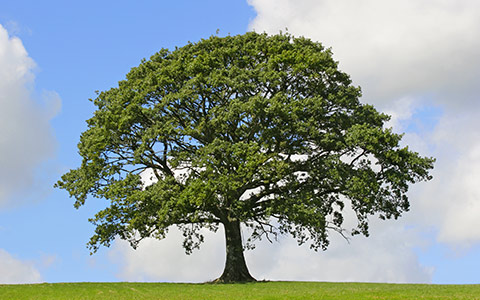
• Southern Magnolia
• Green Ash
• White Oak
• Southern Red Oak
Tip: When planting multiple trees, understory trees can be planted near overstory trees as protection from strong or persistent winds.
For more info, refer to 72tree.com/tree-buying-tips/ before purchasing the trees you intend to plant.
Planting Your Tree
When planting a seedling or sapling, the following should be considered in the preparation of the planting location:
Surrounding Soil – Organic material or pH stabilizing material should be mixed into the soil in no less than a 2-foot radius of where the tree will be planted.
Tip: When transplanting a more developed tree, treat the soil in a 3 to 4-foot radius of the planting location.
Dig the Hole – Measure the distance from the bottom of the trunk to the bottom of the roots or root ball; this is how deep your hole must be. The hole must also be wide enough for the entire root ball to fit without being cramped or bent.
Tip: To confirm the accuracy of the depth, allow the tree to rest in the hole paying particular attention to where the roots connect to the tree. Known as the root flare, it should remain just above the ground.
Water in the Hole – Before planting your tree, provide a deep watering for the hole, allowing water to soak deep into the earth below. This moisture will encourage roots to grow deep.
Plant the Tree – Now that your hole is dug, the soil enriched, and the ground watered, place your tree in the hole covering the roots with soil up to the root flare.
Tip: When covering the roots with soil, do not overly compact it. Water the newly planted tree and allow the soil to settle. As the soil settles, add more to the top, keeping the root flare just above ground level.
Watering – Your newly planted tree should receive a deep watering 2 to 3 times per week. Avoid shallow waterings as they encourage roots to grow to the surface.
Tip: Use a slow-release watering system which maintains constant moisture while allowing proper drainage for excess water.

During rainy seasons, scale back the watering schedule and increase it during periods of drought. Don’t allow the soil to dry out for newly planted trees completely.
Fertilizer – If you have prepared the soil in and around the planting location, no fertilizing should be necessary for the first full year of growth.
Tip: Use organic mulch around the tree. As it decays, mulch releases nutrients into the soil. An added advantage is that mulch helps the soil retain moisture and warmth, both of which are fundamental for healthy root growth.
Tree Planting and Your Landscape
Your tree is likely to struggle and die without considering the factors that influence its growth when it is planted.
In this article, you discovered how to determine the correct tree species for your landscape, how to prepare the planting location, and pro tips to help you avoid common mistakes when planting a tree.
Your lack of knowledge about soil, sun, water, location, and species when planting a tree can result in its declining health and eventual death.
Sources:
extension.umn.edu/planting-and-growing-guides/watering-newly-planted-trees-and-shrubs
static.colostate.edu/client-files/csfs/pdfs/TreePlanting_636.pdf
extension.umn.edu/trees-and-shrubs/choosing-evergreens-your-landscape